
What is an exploded view, and how to read one
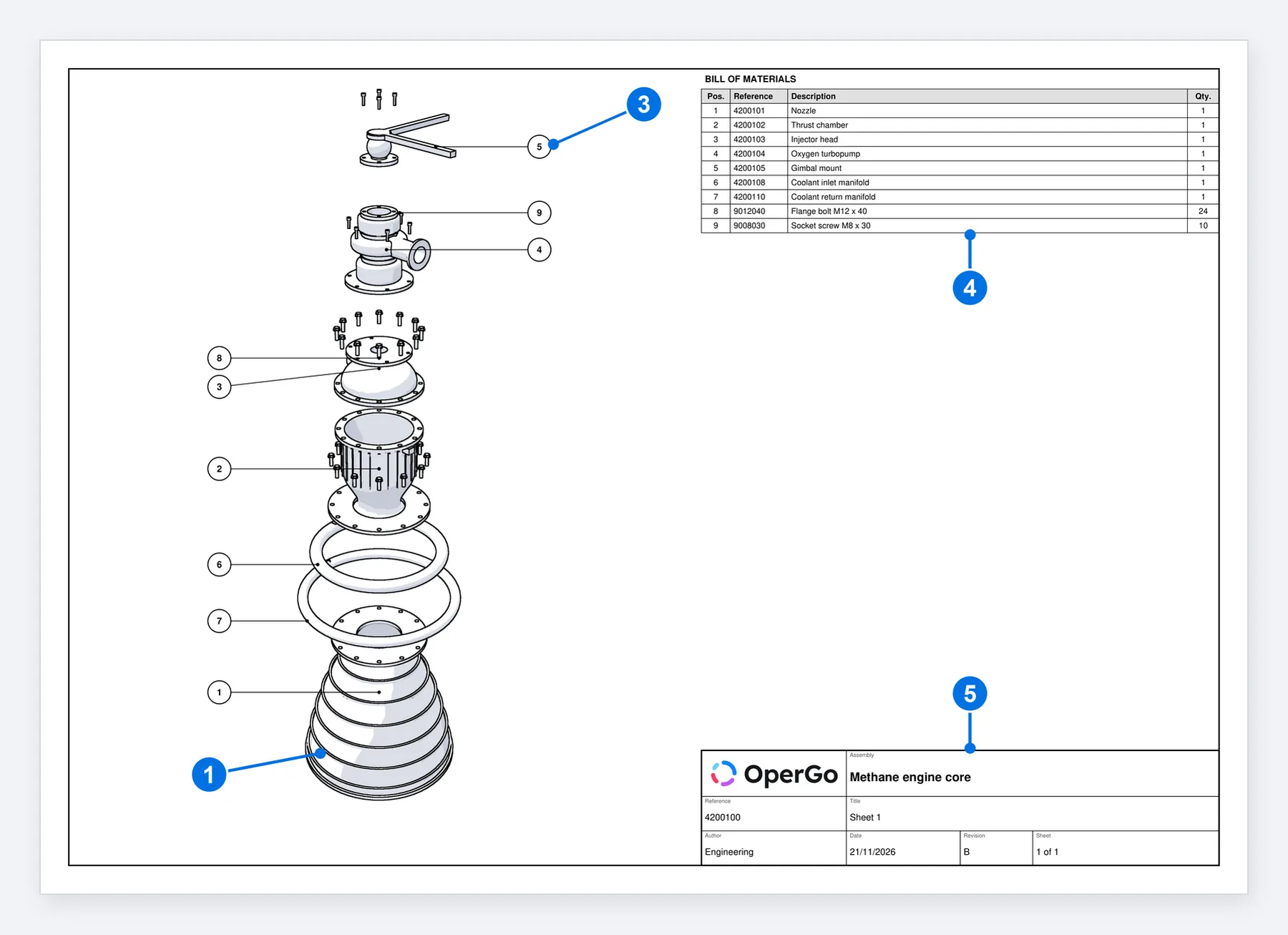
An exploded view is a drawing of a product with its parts separated from one another along the directions in which they assemble. It shows what the product is made of, how each part fits, and in what order it goes together or comes apart.
What it is called
You will see exploded view, exploded diagram, exploded drawing and, in parts catalogs, exploded parts diagram. In Spanish it is vista explosionada or despiece; in French, vue éclatée; in German, Explosionszeichnung; in Italian, vista esplosa.
What it includes
- The parts, separated along their assembly axis, in the order they are placed.
- Explosion lines, thin and often dash-dot, joining each part to where it fits.
- Balloons: a circle with the part number and a leader line to the part.
- The bill of materials (BOM): a table with the number of each balloon, the reference, the description and, if needed, the quantity.
- The title block: assembly name, reference, revision, date and author.
The numbers in the picture match this list. Number 2 is missing: the sheet has no explosion lines, which are not needed when every part sits on the same axis.
What it is for
- Manufacturing and purchasing: know which parts a product has and order them by reference.
- Assembly: understand the order and the direction.
- After-sales and spare parts: let the customer or the service technician point to the part that is missing or failing.
- Documentation and quotes: show a product from the inside without opening CAD.
How to read one
- Look at the whole: you see the product, opened.
- Follow an explosion line to a part: that is where it fits.
- Read its balloon and find that number in the list: you have its name and reference.
- If two parts are one behind the other, the one furthest from the assembly is removed first.
What makes a good exploded view
- Each part leaves along its assembly axis, not "wherever it fits".
- No part passes through another when separating.
- Identical parts go together with the same number (four screws are one balloon, not four).
- Balloons do not overlap and their leader lines do not cross.
- The numbering is consistent with the list, and the list with what purchasing orders.
- Nothing is hidden: a part behind another is separated far enough to be seen.
An example
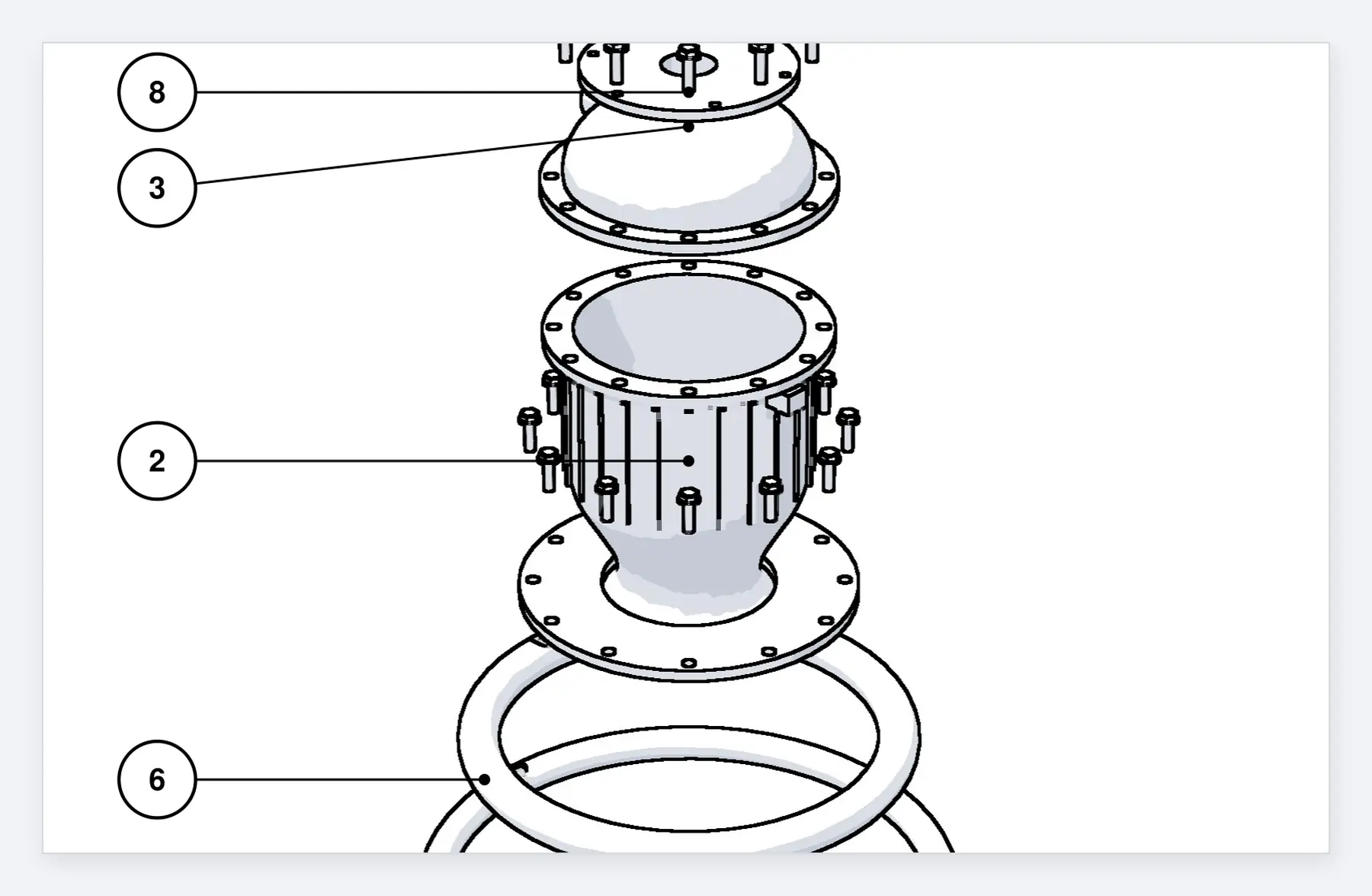
The core of a rocket engine, 41 parts on one axis: nozzle, thrust chamber, injector head, oxygen turbopump, gimbal mount, two ring manifolds and the fasteners. In the exploded view the parts are stacked along that axis, one above the other as they go together; the 24 identical flange bolts carry a single balloon, and the list has 9 rows, each with its reference. It is the example on Composer's home page, where you can see everything you get from a STEP file.
How to make one from a STEP file
If you have the model as a STEP, there is no need to draw it: Composer makes it for you, with numbered balloons, the list and the title block, as PDF and CSV. It is free, and your STEP is not shared with anyone.
Questions
What is the difference between an exploded view and an assembly drawing?
An assembly drawing shows the product assembled, with its parts numbered and a list. An exploded view shows the same with the parts separated, so you can see how they fit.
What is the difference between an exploded view and an assembly manual?
The exploded view is one picture of the whole product, to understand what it has and how it fits. The assembly manual splits it into steps, one per page, with arrows and symbols, so it can be assembled.
Do I need CAD to make one?
To draw it from scratch, yes. With a STEP file, no: you open it in Composer and it comes out.
What is a bill of materials?
The table of the parts of the product, with their number, reference and description. Also called a BOM, for bill of materials. More in bill of materials (BOM) from a STEP file.